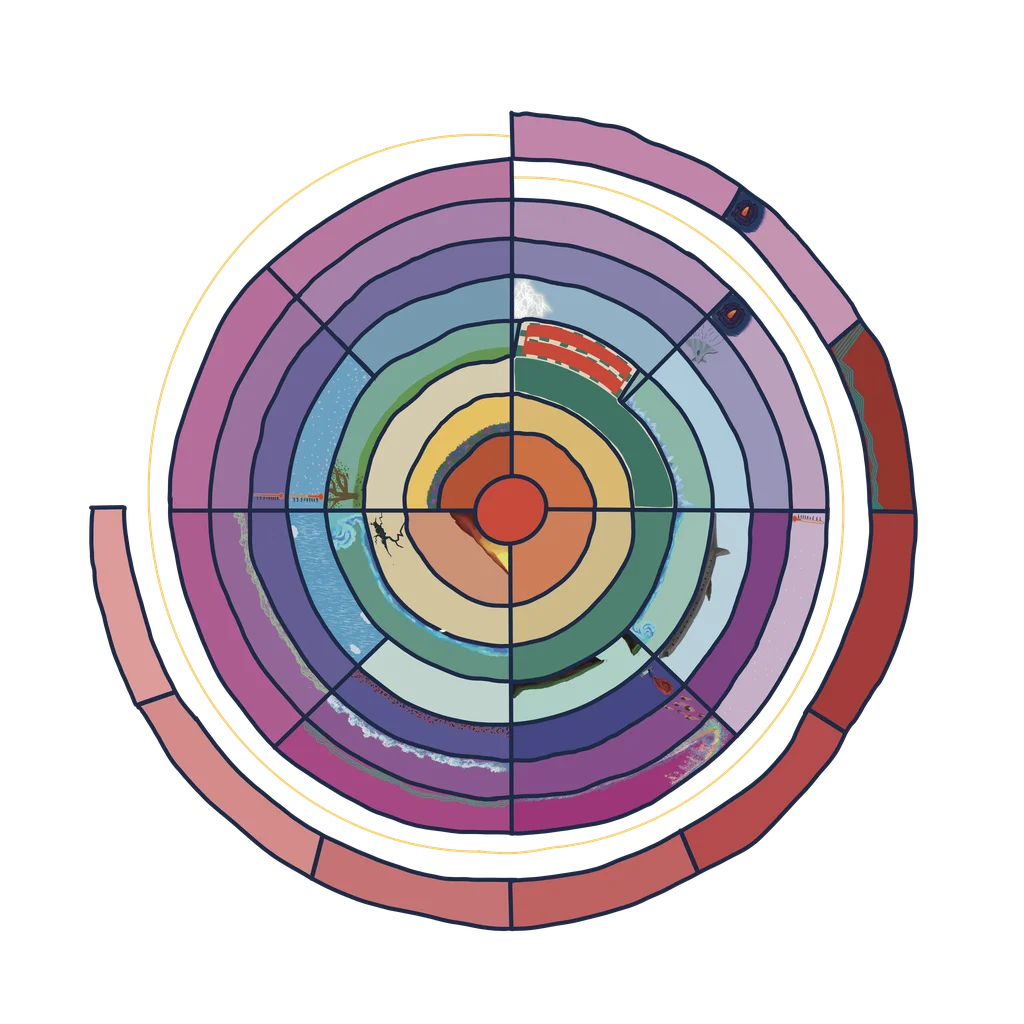
Physics has a reputation problem with kids. By the time it shows up in school, it's already wearing a lab coat and carrying a clipboard full of equations. But here's the thing: every child has been doing physics since birth. They've felt gravity pull them off a slide. They've noticed a paper plane drifts further when they fold it differently. They've pushed a friend on a swing and felt the rhythm of it.
The job isn't to introduce children to physics. It's to give them the language and the aha moments that connect what they already feel to what they can understand. You don't need a lab for that. You need curiosity, a few household objects, and the willingness to get things wrong in interesting ways.
Here are seven activities — all doable at home in India, with zero special equipment — that actually teach physics, not just perform it.
7 Activities in this article
A quick note before we begin: each activity below is paired with a note on EscapeGravity — a science board game made in India — because the physical challenges inside the game were designed around exactly these concepts. If you want to take these experiments further into structured play, EscapeGravity is a natural next step.
The Gravity Drop Test
This is the oldest physics experiment in the book — and it still works every time. Hold a coin and a flat sheet of paper at the same height and drop them simultaneously. The coin hits the ground first. Ask your child: why?
Now crumple the paper into a tight ball and drop them again. They land almost simultaneously. What changed? The paper's weight didn't change. Its shape did — and with it, the air resistance pushing back against it as it fell.
What to discuss: Gravity pulls all objects equally, regardless of mass. (Galileo famously demonstrated this by dropping cannonballs from the Tower of Pisa.) But air resistance slows objects based on their surface area and shape. The flat paper has enormous surface area relative to its weight — it practically floats. The crumpled ball cuts through the air efficiently.
Push further: Try a book and a piece of paper placed on top of the book — dropped together. The paper rides in the book's "shadow" and falls at the same rate. Now you're in Galileo territory.
Build a Pendulum
Tie a weight to a length of string and hang it from a fixed point — a doorknob, a curtain rod, or a pencil balanced between two stacks of books. You've built a pendulum. Now the experiment begins.
Ask your child to predict: what makes it swing faster — a heavier weight, a longer string, or how far you pull it back? Let them guess, then test each variable systematically. Change one thing at a time. Count swings over 30 seconds.
What they'll discover: The length of the string is the only thing that changes the period. Heavier weights don't swing faster. Bigger starting angles don't change the timing (for moderate angles). This surprises almost every child — and most adults. That surprise is the physics lesson.
Real-world connection: Grandfather clocks keep time with a pendulum. The length of the pendulum is precisely calibrated so it swings exactly once per second. Your child just discovered how that works.
The Feather vs Coin Race — Air Resistance in Action
Drop a feather and a coin from the same height. The coin wins, easily. Now try to make the feather fall faster — fold it, flatten it, angle it differently. Explore what shapes fall faster and what shapes drift.
For a more dramatic version: cut identical squares from different materials — tissue paper, normal paper, card, foil — and drop them all simultaneously. Observe which falls fastest and ask why.
Introduce terminal velocity: Why does a raindrop fall at a steady speed instead of accelerating forever? Because as it speeds up, air resistance increases — until drag equals gravity and the drop stops accelerating. That's terminal velocity. Skydivers experience it. So does your feather.
Make it a competition: Each child designs a paper "parachute" from a single sheet — folds, cuts, and shapes allowed. Drop them from the same height. Whose stays up longest? Now they're engineers, not just observers.
Friction Slopes — Why Things Stop
Set a flat board (a hardcover book works perfectly) at a slight angle against a wall or step. Place a small object at the top and let it slide. Now cover the board with different materials: a rough towel, a plastic bag, sandpaper, a piece of velvet. How does the sliding change?
What to explore:
- Which surface lets things slide fastest? Which stops them quickest?
- Does the weight of the object change how fast it slides?
- What angle does the board need to be before a heavy book won't move?
The science: Friction is the force that resists motion between two surfaces. It depends on the texture of both surfaces and on how hard they press together (the normal force) — but not, surprisingly, on the area of contact. A large block and a small block of the same weight experience the same friction on the same surface.
Real-world connection: Ask why car tyres have grooves (tread). Why do we put sand on icy roads? Why do rock climbers use chalk? Friction is everywhere — and suddenly children see it everywhere too.
Finding Your Centre of Gravity
Here's a physics trick that requires nothing but a wall. Ask your child to stand with their back against the wall, feet together touching the wall. Place a coin on the floor about 30 cm in front of them. Now challenge them to pick it up without bending their knees — and without falling forward.
They can't do it. Nobody can. (Try it yourself first to confirm.) The reason is that the wall prevents them from shifting their hips back to counterbalance the weight of their torso as they lean forward. Their centre of gravity — the point where all their weight effectively acts — tips forward of their feet, and they topple.
Explore further: Why do tightrope walkers carry long poles? (The poles lower their centre of gravity.) Why do racing cars have such low profiles? (Lower centre of gravity means less tipping in corners.) Why do sumo wrestlers crouch so wide? You already know the answer now.
Balance challenges: Try balancing a ruler on one finger, finding the exact balance point. Try balancing a fork and spoon on a toothpick using a folded piece of card — it looks impossible until the centre of gravity is right below the pivot point.
String and Spin — Understanding Orbital Motion
Tie a small weight — a rubber eraser works well — to a string about 50 cm long. Swing it in a circle above your head (outdoors or in a room with nothing fragile). Speed up. Slow down. Let the string go suddenly (carefully — aim at a wall or soft target).
The question: What keeps the weight going in a circle instead of flying off in a straight line? The string — pulling the weight inward. That inward pull is called centripetal force. Without it, the weight would travel in a straight line (Newton's First Law).
And now the leap: The Moon orbits Earth for the same reason. Gravity is the string. The Moon is always "falling" toward Earth — but it's moving so fast sideways that it keeps missing. That's an orbit. The Moon is in permanent free fall, and has been for 4.5 billion years.
Watch your child's face when that clicks. That's the moment physics stops being a school subject.
Action and Reaction Balloons
Thread a long string through a drinking straw. Tie the string between two fixed points — two chairs, a doorknob and a hook — so it's taut and horizontal. Inflate a balloon, pinch the end (don't tie it), and tape it to the straw. Release.
The balloon rockets across the string. It goes further with more air. It goes faster when the opening is narrower. It goes in a straight line as long as the string guides it.
Newton's Third Law in one sentence: Every action has an equal and opposite reaction. The balloon pushes air out backward. The air pushes the balloon forward. That's every rocket ever launched. It's also why you slide backward on socks if you push a door.
Make it a race: Whose balloon travels further? Whose goes fastest? Whose launches highest if you angle the string upward? Children who have built a balloon rocket intuitively understand rocket propulsion in a way that no diagram ever produces.
Bringing It All Together
These seven activities cover the core of what Indian school physics curricula cover in classes 6 through 9 — gravity, forces, friction, motion, and orbital mechanics. Done casually over a few weeks, they build a physical intuition that makes every subsequent classroom lesson feel like recognition rather than new information.
The most important thing isn't the experiment itself — it's the conversation it generates. When a child drops a crumpled paper ball and asks why does it fall faster now?, they are doing science. Protect that curiosity. Resist the urge to explain before they've guessed.
Turn These Experiments Into a Game
EscapeGravity is a science board game built around exactly these concepts — gravity, air resistance, friction, orbital motion — with 35+ physical challenges that make kids feel the physics. Made in India for kids aged 7+.
Order at ₹4,249 — 15% off
Order EscapeGravity →A Note on Going Deeper
Each of these activities can be extended. The gravity drop test can lead into discussions about vacuum — what would happen if there were no air at all? (Everything falls at exactly the same rate — and you can demonstrate this with a YouTube video of a feather and hammer dropped on the Moon.) The pendulum experiment can lead into the history of timekeeping. The balloon rocket can lead into actual rocket design and why the International Space Station stays in orbit.
The goal isn't to exhaust each topic in one session. Plant the seed, let it grow at the child's pace, and revisit when something in the world triggers the memory. A rainstorm is a reminder of air resistance. A playground swing is a pendulum. A car turning a corner is centripetal force. Physics is everywhere — once you've seen it once, you can't un-see it.
Ready to Make Physics a Game Night?
EscapeGravity takes everything you've explored in these activities and turns it into a 30-minute board game your whole family can play. India's first physics board game with real physical challenges.
Order Now →